


How different are anxiety, OCD, trauma, and eating disorders?

In the therapy world, there are three distinct camps: anxiety and OCD specialists, trauma specialists, and eating disorder specialists. The trauma folks feel that their condition is distinct because their patient has experienced a true and not imagined dangerous situation. The eating disorder crowd feels their disorders are unique because they can very directly impact physical health and lead to a hospitalization.
In reality, the disorders share much in common and it could be argued that anxiety and avoidance are at the core of all of them. In anxiety disorders, the fear trigger leads to avoidance of not only that trigger but also many things related to it. In OCD, people are often anxious about an intrusive thought or image and engage in compulsions and avoidance behavior to cope. In Posttraumatic Stress Disorder (PTSD), after the legitimately dangerous situation is over, people still struggle with anxiety and avoid thought/situations/people/things/emotions that remind them of the incident. People with eating disorders experience anxiety about food and eating and either avoid eating or avoid discomfort about eating by engaging in compensatory behaviors such as vomiting or over-exercising.
Take a look at this Venn diagram for a more detailed explanation:
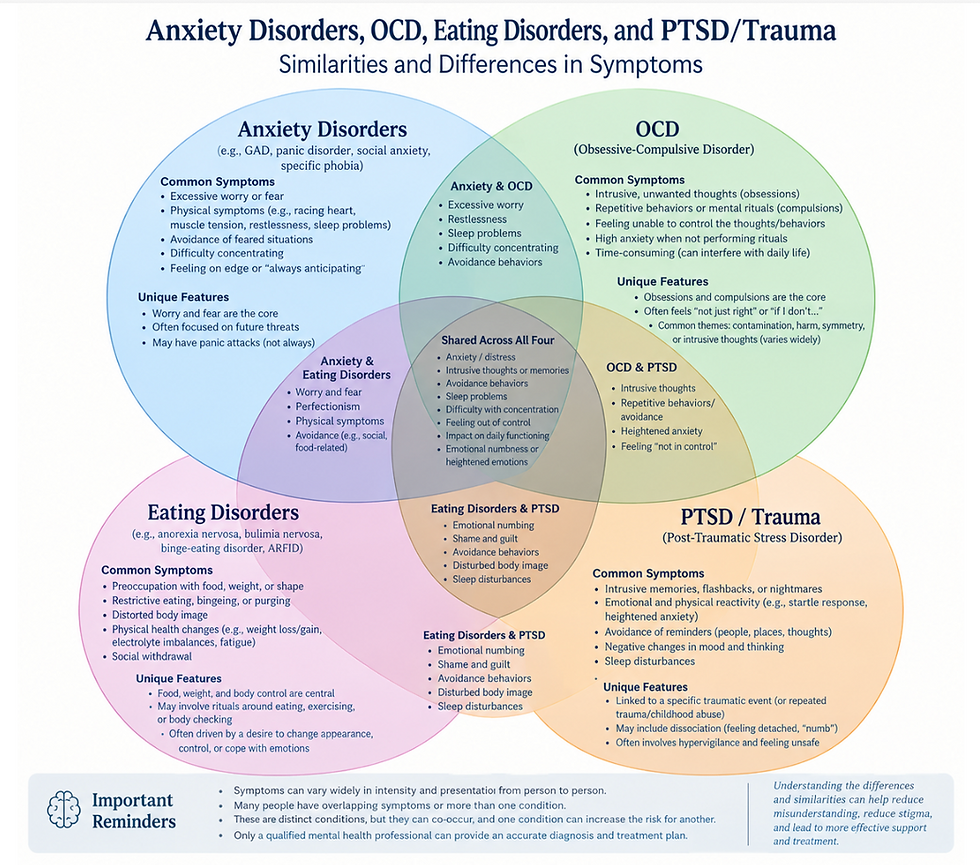
Because of the similarities in the disorders and their treatment (which generally involves cognitive-behavioral therapy techniques and exposure therapy), many anxiety/OCD specialists feel comfortable treating at least mild-to-moderate presentations of eating disorders and PTSD, leaving the more challenging cases to the specialists in those respective camps.
While anxiety disorders and OCD are my specialty, I particularly have an interest in treating children and adults with ARFID (those who are medically stable). I also work with people who have completed eating disorder treatment and are transitioning to care for the anxiety disorder or OCD that commonly presents with the eating disorder. I am trained in TF-CBT and Prolonged Exposure for PTSD and can work with cases in which the individual is currently safe and able to engage in treatment without higher priorities. I also have training in DBT and can support people transitioning out of a group and into outpatient care to address other concerns.


Comments